Kazpost driving e-commerce and SPS growth across Central Asia
Published on

The rapid growth of online shopping has increased expectations for faster and more transparent delivery services. SPS Kazpost has responded by continuously enhancing its operational capabilities and expanding its logistics infrastructure to meet the growing needs of e-commerce merchants and consumers. Whether supporting small businesses selling products abroad or enabling consumers to receive international purchases quickly and securely, SPS Kazpost has developed into a significant international express operator operating within Kazakhstan, across Central Asia, and beyond.

Strategic position for e-commerce and SPS growth
Kazpost’s SPS growth has been helped by Kazakhstan’s dual advantage as Central Asia’s largest economy and its strategic location along the Silk Road, linking Asia and Europe. This economic and geographic position has helped transform Kazakhstan to a rising e-commerce logistics hub both regionally and worldwide. The country is well suited to e-commerce expansion, with internet penetration reaching 93% of the population, one of the highest rates in Asia.
Kazakhstan’s government has set a goal to increase e-commerce’s share of total retail trade to 20% by 2030. This has been supported by recent government development programmes with a focus on expanding its transportation and logistics infrastructure, strengthening payment channels, and pursuing digital transformation initiatives. As a result, e-commerce is booming with a significant share of incoming traffic originating from online marketplaces. The government’s vision for the postal sector provides a supportive environment for e-commerce and SPS growth, with Kazpost recognized as a national commercial and infrastructure asset.
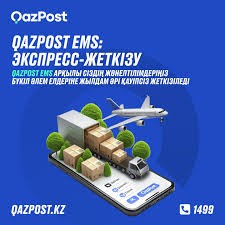
Going the last mile
Despite increasing in urbanization, Kazakhstan
remains a very large land mass with significant
portions of the populations living in remote and
isolated areas. In this context, a unique strength
is Kazpost’s nationwide network which provides
access to e-commerce but also to financial and
government services to a widely dispersed
population, supporting financial and social
inclusion.
With a network of over 2,400
post offices, Kazpost plays a critical role in
enabling internet-based retail by facilitating
nationwide delivery. This is further strengthened by
Kazakhstan’s comprehensive address infrastructure,
which supports efficient and reliable last-mile
delivery across the country.
Integrated services strengthening market position
Kazpost’s market position is strengthened by its
ability to adapt to evolving e-commerce demands,
integrating logistics, payments, and data, and
modernizing customs processes. By combining
investment with corporate autonomy, fiscal and
operational discipline, strategic partnerships, and
aggressive marketing, it has competed successfully
in a highly competitive market.
Kazpost
is rapidly digitizing the three legs of e-commerce:
logistics, payments, and data, while offering a
broad range of commercial and government services
through its website, social platforms, and media
channels. These include financial services (such as
payment cards and digital payments), agency
services, government outreach (e.g. pension
distribution), logistics solutions, customs
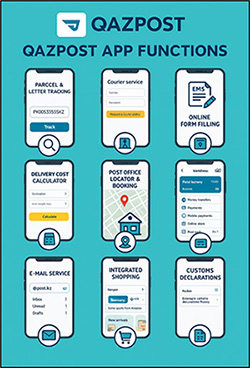
facilitation and parcel lockers. The QazPost Super
App serves as a central access point for these
services (pictured).
Kazpost commercial strategy - adapting to the
market
Kazpost is pursuing a range of initiatives to
strengthen its competitiveness in inbound
international e-commerce and SPS. These include
streamlining customs procedures, adopting
automated sorting and robotics, and enhancing
last-mile delivery using AI and advanced
analytics. The company is also advancing its
digital transformation through strategic
partnerships with high-tech companies such as
Toshiba.
At the same time, Kazpost is investing resources
in infrastructure modernization and expansion,
including the development of full-cycle logistics
centres in three cities and a bonded warehouse to
reinforce its role as a regional and international
transit hub. Additionally, Kazpost is actively
building partnerships, with memoranda of
understanding in place with multiple designated
operators, and has recently launched a Central
Asia alliance that brings together regional
operators alongside major Chinese logistics and
cargo transport firms.
Innovation and sustainability are
important components of Kazpost’s strategy. Under
the UPU Quality of Service Fund (QSF), which
supports developing countries in implementing
projects aimed at improving service quality, Kazpost
has received approval to acquire new electric
vehicles and bicycles. These eco-friendly solutions
will strengthen last-mile delivery capabilities,
improve operational efficiency, and contribute to
faster and more reliable delivery services for
customers.
The modernization of the delivery fleet is expected to enhance service quality, particularly in urban areas where speed, flexibility, and environmental considerations are becoming increasingly important. Combined with ongoing investments in digital technologies, tracking systems, and operational processes, these improvements will further strengthen SPS Kazpost’s ability to meet the demands of the rapidly growing e-commerce market.
* This article is based on data from a detailed Kazpost case study featured in DAP's 2025 Market Intelligence Report, available exclusively to SPS Cooperative members.